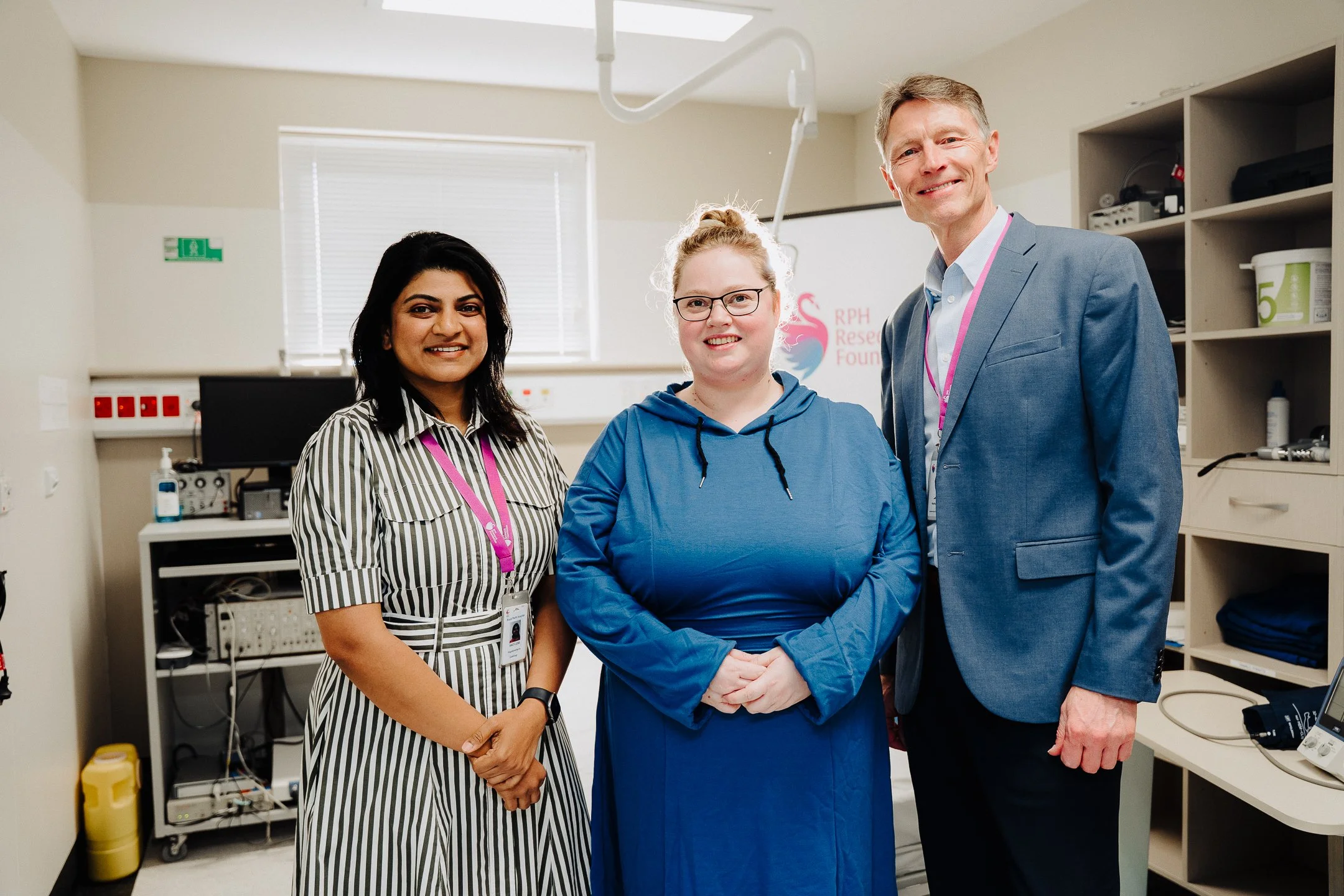
Image (L-R): Ancy Jose (Research Nurse, Dobney Hypertension Centre), Rebekah Phythian (GEMINI-On Med Clinical Trial Participant), Professor Markus Schlaich (Dobney Chair in Clinical Research, Dobney Hypertension Centre)
The results of a first-in-human study exploring the safety and efficacy of a novel procedure aimed at lowering blood pressure and improving metabolic health have just been published in the European Heart Journal. The encouraging improvements have informed an ongoing trial with this innovative procedure at Royal Perth Hospital (RPH).
Among the first patients treated is Rebekah Phythian, 38, of Mandurah. She has been involved in the GEMINI-On Med clinical trial at the Dobney Hypertension Centre (DHC) at RPH and underwent an interventional procedure on her arteries in February 2026.
For years, Rebekah has lived with the uncertainty of uncontrolled high blood pressure. Diagnosed in her twenties after experiencing persistent nausea and headaches, she remembers the fear that came with hearing she needed urgent tests and further investigations.
"I went back to my car and bawled my eyes out because I was so scared," Rebekah recalls. "I thought, am I dying?"
Today, thanks to this clinical trial at DHC, Rebekah is feeling something she hasn't felt in a long time: hope.
Within a month of her procedure, she had reduced her blood pressure, lost weight and improved her cholesterol and triglyceride levels, with no complications reported.
Her procedure is known as a combined bilateral kidney and liver denervation. It is a catheter-based multi-organ denervation of the kidney and liver arteries. It works by disrupting signals between the brain and the respective organs.
This minimally invasive procedure is being investigated as a potential new treatment for people living with difficult-to-control high blood pressure (hypertension) and metabolic disease.
Professor Markus Schlaich said the early results are promising and reinforce the importance of ongoing clinical research into new therapies for cardiovascular disease.
He said blood pressure reductions from this type of procedure are projected to lead to meaningful results for patients with difficult-to-control hypertension.
The first-in-human study informed the current trial and demonstrated the safety and efficacy of combined renal and hepatic denervation, with improvements observed in both blood pressure and metabolic health.
Professor Schlaich said one in three Australians suffered from high blood pressure (above 140/90 mmHg).
For a subset of these patients, their blood pressure cannot be controlled despite the use of three or more medications, putting them at risk of poor health. These patients are regarded as “treatment resistant”.
“Given the high rates of uncontrolled hypertension, expanding treatment options to help our patients reduce their blood pressure is particularly important,” he said.
Attending a follow-up appointment with Professor Schlaich at RPH on Monday 3 August, Rebekah said rather than add more daily medications to combat her high blood pressure, she was willing to take part in the trial.
"After the procedure I just thought, phew."
“I used to have to spend so much time thinking about medications and worrying about my blood pressure, now all new possibilities have opened up,” she said.
Having always wanted to travel but feeling too anxious to do so with uncontrolled blood pressure, Rebekah has since booked her first overseas trip since her diagnosis.
Her ambulatory blood pressure fell from 148/103 to129/95.
These patient outcomes build on the findings of a first-in-human study recently published in the European Heart Journal, which demonstrated the safety and efficacy of combined renal and hepatic denervation, with improvements observed in both blood pressure and metabolic health. The results helped inform the ongoing trial now underway at Royal Perth Hospital.
The article is entitled “Combined hepatorenal denervation for hypertension and cardiometabolic disease: a first-in-human study.”
Through the support of donors, the RPH Research Foundation is helping researchers like Professor Schlaich and the team at the Dobney Hypertension Centre pursue innovative treatments that have the potential to change lives. For patients like Rebekah, that support is already making a difference.
The Dobney Hypertension Centre, a partnership between Royal Perth Hospital, the University of Western Australia and the RPH Research Foundation, is leading innovative research into new ways of treating difficult-to-control high blood pressure. This important work is made possible through the support of the RPH Research Foundation and its generous donors, who help fund research that can transform lives.
Image (L-R): Ancy Jose (Research Nurse, Dobney Hypertension Centre), Rebekah Quinnel (GEMINI-On Med Clinical Trial Participant), Professor Markus Schlaich (Dobney Chair in Clinical Research, Dobney Hypertension Centre)
The results of a first-in-human study exploring the safety and efficacy of a novel procedure aimed at lowering blood pressure and improving metabolic health have just been published in the European Heart Journal. The encouraging improvements have informed an ongoing trial with this innovative procedure at Royal Perth Hospital (RPH).
Among the first patients treated is Rebekah Quinnell, 38, of Mandurah. She has been involved in the GEMINI-On Med clinical trial at the Dobney Hypertension Centre (DHC) at RPH and underwent an interventional procedure on her arteries in February 2026.
For years, Rebekah has lived with the uncertainty of uncontrolled high blood pressure. Diagnosed in her twenties after experiencing persistent nausea and headaches, she remembers the fear that came with hearing she needed urgent tests and further investigations.
"I went back to my car and bawled my eyes out because I was so scared," Rebekah recalls. "I thought, am I dying?"
Today, thanks to this clinical trial at DHC, Rebekah is feeling something she hasn't felt in a long time: hope.
Within a month of her procedure, she had reduced her blood pressure, lost weight and improved her cholesterol and triglyceride levels, with no complications reported.
Her procedure is known as a combined bilateral kidney and liver denervation. It is a catheter-based multi-organ denervation of the kidney and liver arteries. It works by disrupting signals between the brain and the respective organs.
This minimally invasive procedure is being investigated as a potential new treatment for people living with difficult-to-control high blood pressure (hypertension) and metabolic disease.
Professor Markus Schlaich said the early results are promising and reinforce the importance of ongoing clinical research into new therapies for cardiovascular disease.
He said blood pressure reductions from this type of procedure are projected to lead to meaningful results for patients with difficult-to-control hypertension.
The first-in-human study informed the current trial and demonstrated the safety and efficacy of combined renal and hepatic denervation, with improvements observed in both blood pressure and metabolic health.
Professor Schlaich said one in three Australians suffered from high blood pressure (above 140/90 mmHg).
For a subset of these patients, their blood pressure cannot be controlled despite the use of three or more medications, putting them at risk of poor health. These patients are regarded as “treatment resistant”.
“Given the high rates of uncontrolled hypertension, expanding treatment options to help our patients reduce their blood pressure is particularly important,” he said.
Attending a follow-up appointment with Professor Schlaich at RPH on Monday 3 August, Rebekah said rather than add more daily medications to combat her high blood pressure, she was willing to take part in the trial.
"After the procedure I just thought, phew."
“I used to have to spend so much time thinking about medications and worrying about my blood pressure, now all new possibilities have opened up,” she said.
Having always wanted to travel but feeling too anxious to do so with uncontrolled blood pressure, Rebekah has since booked her first overseas trip.
Her ambulatory blood pressure fell from 148/103 to129/95.
These patient outcomes build on the findings of a first-in-human study recently published in the European Heart Journal, which demonstrated the safety and efficacy of combined renal and hepatic denervation, with improvements observed in both blood pressure and metabolic health. The results helped inform the ongoing trial now underway at Royal Perth Hospital.
The article is entitled “Combined hepatorenal denervation for hypertension and cardiometabolic disease: a first-in-human study.”
Through the support of donors, the RPH Research Foundation is helping researchers like Professor Schlaich and the team at the Dobney Hypertension Centre pursue innovative treatments that have the potential to change lives. For patients like Rebekah, that support is already making a difference.
The Dobney Hypertension Centre, a partnership between Royal Perth Hospital, the University of Western Australia and the RPH Research Foundation, is leading innovative research into new ways of treating difficult-to-control high blood pressure. This important work is made possible through the support of the RPH Research Foundation and its generous donors, who help fund research that can transform lives.